Artificial Intelligence
12 Feb 2026
3 MIN READ
No, AI is not 'INSANE'. But AI influencers might be.
WRITTEN BY
Adrian Griffith
No, AI is not 'INSANE'. But AI influencers might be.
Suffering from 'AI Fatigue'? Me too!
Trying to stay on top of any trend can be exhausting, but none more so than AI. At least that's how it feels.
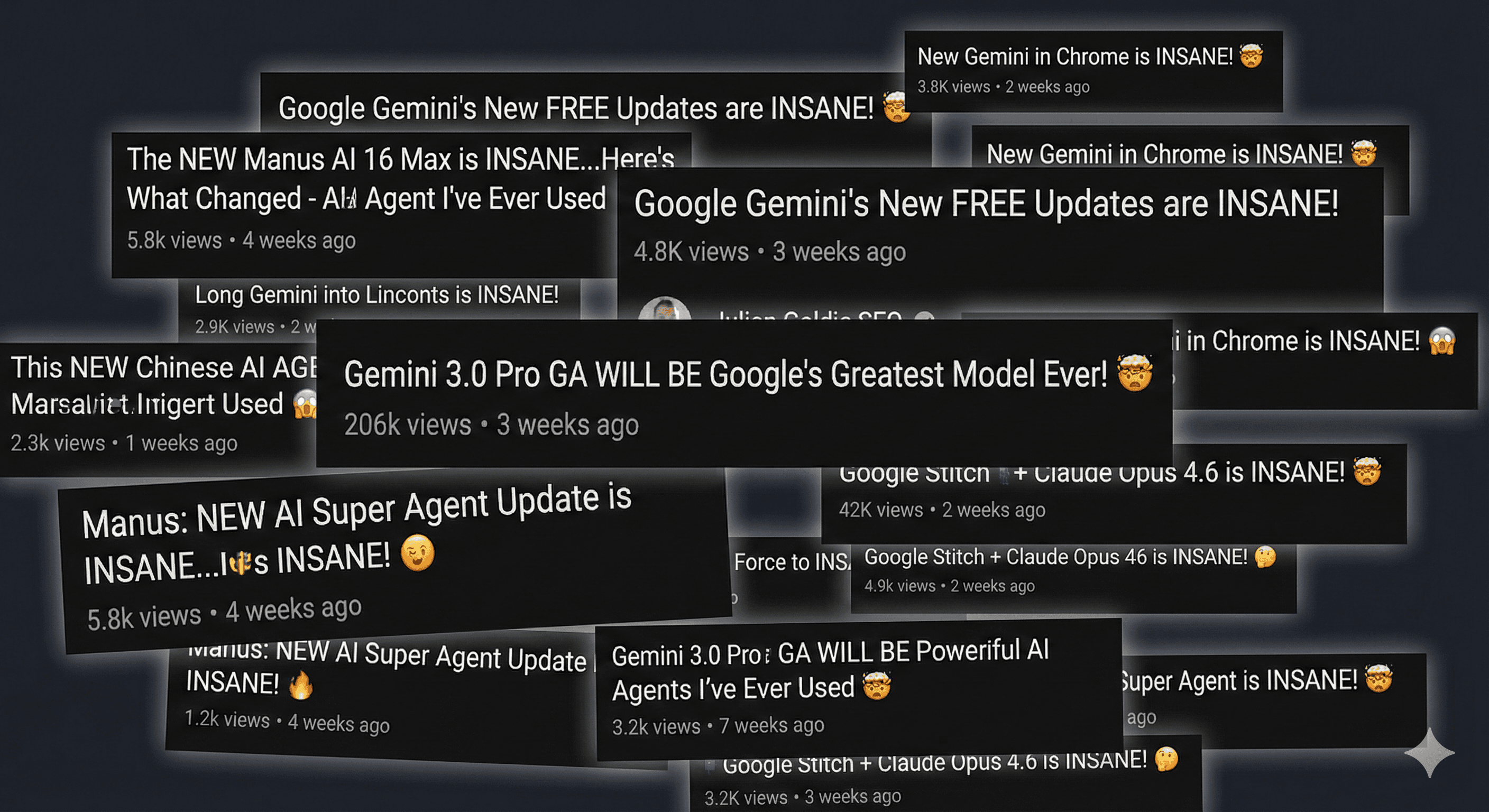
Just on YouTube alone, the constant stream of clickbait-optimised, sensationalised headlines is utterly torrential. Keeping up with the latest AI tools, news, and 'hacks' is tantamount to trying to "catch a deluge in a paper cup" (Neil Finn - I suspect he wasn't thinking of AI when he wrote that lyric).
On any given day I see countless formulaic thumbnails shouting "[tool/platform/model] is INSANE!!!" The same goes for variants: "...is MINDBLOWING", "...JUST CHANGED THE GAME", and perhaps the most damaging, albeit less sensational: "...YOU NEED TO KNOW!"
It's exhausting, and who even talks like that, anyway?
Take some comfort from the fact that there are well-established terms to describe what you might be feeling: AI Fatigue, Technostress, Digital Burnout, Techno-insecurity.* Or just plain old apathy. However you frame it, the struggle is real.
So what's the alternative?
Well, I certainly wouldn't recommend ignoring AI (that's just avoidance); but engaging with it strategically.
As a personal/individual user:
Start with outcomes, not tools. What do you actually need to achieve? Better productivity in spreadsheets? Faster research? Generate user stories? Find tools that deliver those specific outcomes, not tools that promise everything.
Set a tool budget. Limit the number of tools you'll use for a fixed period. Get to know them properly. Do the work with what you've chosen rather than constantly switching.
Commit to what resonates. The main AI models aren't people, but they do have distinct personalities. If you find one that suits your working style, stick with it. New releases from competitors don't automatically make your choice obsolete. You don't need to try everything.
For advanced users: Platforms like Perplexity or Lindy let you pick underlying models depending on the task. This lets you benefit from different models without constantly changing platforms.
As a corporate entity:
Stop letting FOMO drive your AI strategy. Get back to first principles. What's your company's mission? What do you need to get better at? Where might AI actually add value? We've seen companies rush to "implement AI" without understanding what problem they're solving, resulting in expensive tools nobody uses.
Seek professional input. Your company exists to make widgets or provide a service, not to be the authority on AI (unless that literally is your business). Either leverage consultancy expertise, or build an in-house team with the remit to research and deliver meaningful, outcome-focused solutions.
Don't just dive in. Nobody wants to be left behind, but hasty adoption comes at a price. We've all heard about companies who adopted AI tools without proper governance and ended up with confidential data in public models, or compliance teams discovering shadow AI usage months after deployment. Let things settle, then make measured, strategic, responsible choices.
The AI hype machine isn't going anywhere. But you don't have to play the game.
Ignore the 'INSANE' headlines. Focus on what actually moves the proverbial needle for you or your business. And remember, the best AI strategy is more about using the right tools well, than having all the latest tools.
*Terms drawn from research on AI fatigue and digital burnout. See: "Too Much, Too Fast: Understanding AI Fatigue In The Digital Acceleration Era" (ResearchGate) - Well worth a read!